
Church and Convent of La Merced — Art, water and Baroque in the heart of Antigua Guatemala
Introduction
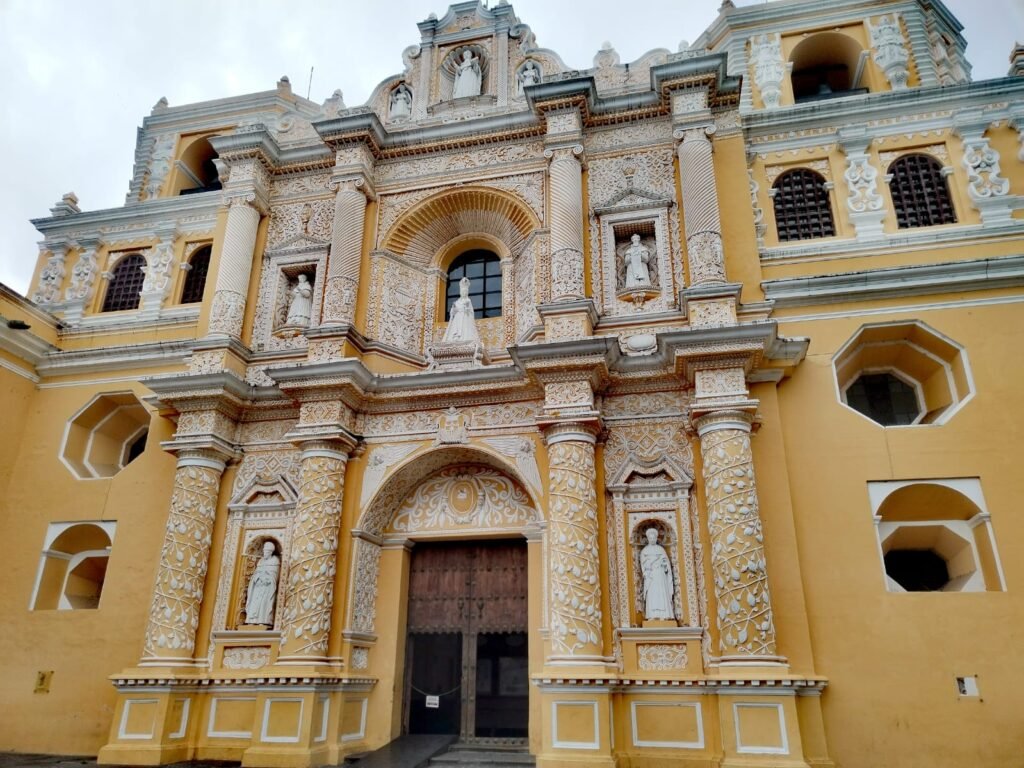
The Church and Convent of Our Lady of Mercy in Antigua Guatemala is one of the country’s most emblematic monumental complexes: a synthesis of faith, ultra-Baroque architecture, decorative arts, and urban landscaping. Its gilded and elaborately modeled façade, its twin towers, the enormous fountain within the convent grounds, and the traces of the artistic workshops that once thrived there make La Merced a place where history is experienced with all the senses. This article explores its architectural origins, its religious and social role, the significance of the main fountain, the Mercedarian presence in Guatemala, and the artistic features—including the mark of the great masters—that make it an unmissable destination for anyone visiting Antigua. Wikipedia
Origins of the order and arrival in Guatemala
The Order of Mercy (Mercedarian Order), founded in the 13th century by Saint Peter Nolasco with the mission of freeing captives, was one of the first religious orders to establish itself in what is now Guatemala. The Mercedarians played an active role in evangelization and the founding of convents and missions throughout the 16th century, first settling in the Almolonga Valley and, after the natural disasters of that era, in the Panchoy Valley, where Antigua Guatemala was later established. Their presence and resources soon allowed them to undertake the construction of a convent befitting their religious standing. Wikipedia
Construction chronology: master builders and key dates
The work we know today integrated several phases and master hands:
- The main construction of the temple, in its most recognizable form, corresponds to the 18th century period; Juan de Dios Estrada is cited as the architect responsible for works from 1749 and for the inauguration of the temple in 1767. Wikipedia
- However, the imprint of earlier artists and masters appears in details and complementary works (fountains, stucco, sculptures) that date back to artistic scenes from the first third of the 18th century and even earlier; therefore, the whole is the result of a continuous artisan tradition. laantiguaguatemala.com
The facade: Guatemalan ultrabaroque and its sculptural language
The façade of La Merced is a prime example of Guatemalan ultra-Baroque architecture: a symmetrical, vertical composition that alternates niches with statues, Solomonic columns in relief, vegetal motifs, and mascarons. The ensemble balances exuberant ornamentation with structural solutions designed for a seismic context (compact volumes, solid foundations). At the top appear Mercedarian figures—including Saint Peter Nolasco—and the Order’s coat of arms; this iconographic repertoire underscores the community’s identity and mission. laantiguaguatemala.com
The convent and the main fountain: function, scale and symbolism
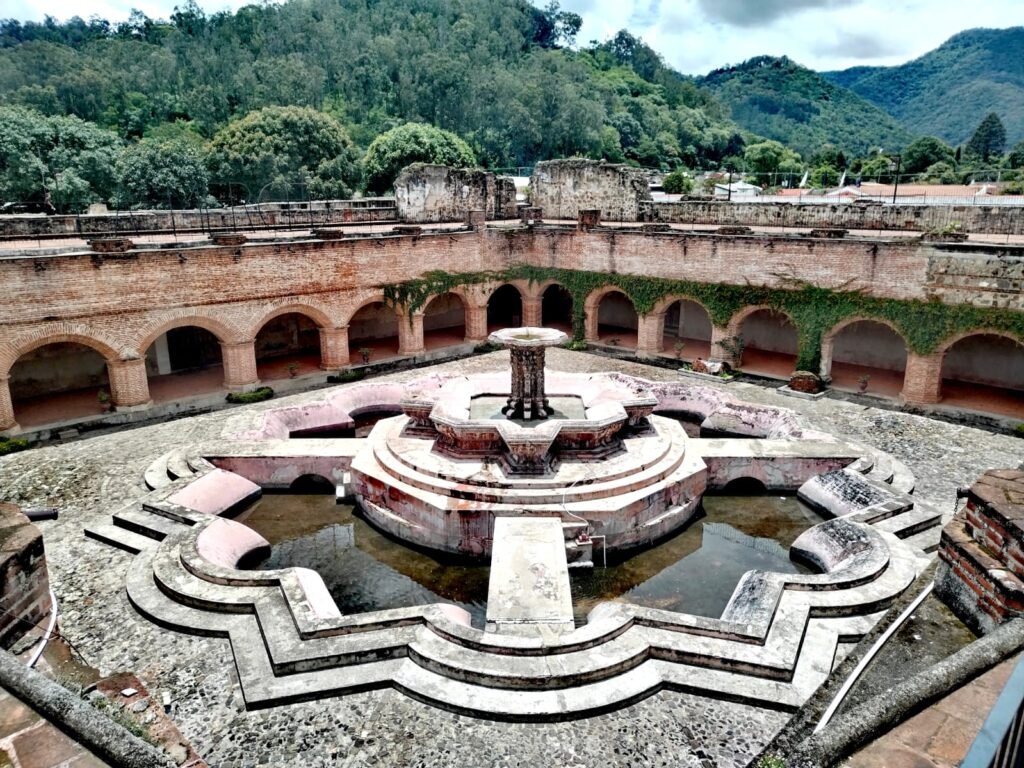
Behind the church lies the former Mercedarian convent, now partially in use and partially in stabilized ruins. One of the most striking features of the complex is the large octagonal fountain that occupies the convent’s main courtyard: with a diameter of approximately 27 meters (according to several local sources), it is recognized as one of the largest colonial fountains in Latin America and the largest in Antigua. The basin is designed as a series of stepped platforms and basins—with shapes reminiscent of lilies or marine motifs—and its presence is not accidental: in American Baroque architecture, water is a symbol of life, purification, and communal wealth; moreover, it served as both a reservoir and an ornament in a space that combined the utilitarian and the symbolic. Guatemala.com
Art and workshops: stucco, religious imagery and the signature of Diego de Porres
The artistic ensemble of La Merced brings together altarpieces, religious imagery, stucco work, and wood carvings that contribute to its visual richness. A recurring element in Antigua is the motif of the mermaids or nereids, which appear in various fountains and ornaments throughout the city. This ornamental repertoire has been associated with Diego de Porres, a master who left his mark on local architecture and sculpture and whose hand is evident in the design of several urban features—including the aquatic and sculptural decoration of fountains. The surviving carvings and stucco works showcase a local school that combined Spanish influences with technical adaptations and motifs characteristic of the New Spanish Baroque style. AntiguaDailyPhoto.Com
Religious and devotional function: Jesus of Nazareth of La Merced and local practices
La Merced was historically a center of intense devotion: processions, patron saint festivals, and the veneration of Jesus of Nazareth of La Merced formed part of the city’s religious fabric. During the Bourbon reforms and the relocation of the capital (18th century), images and objects of great value were moved between cities—an episode that marked the relationship between the Church and civil authorities—; however, La Merced retained its religious significance and its capacity to attract devotion to this day. Wikipedia
Damage, restorations and current state
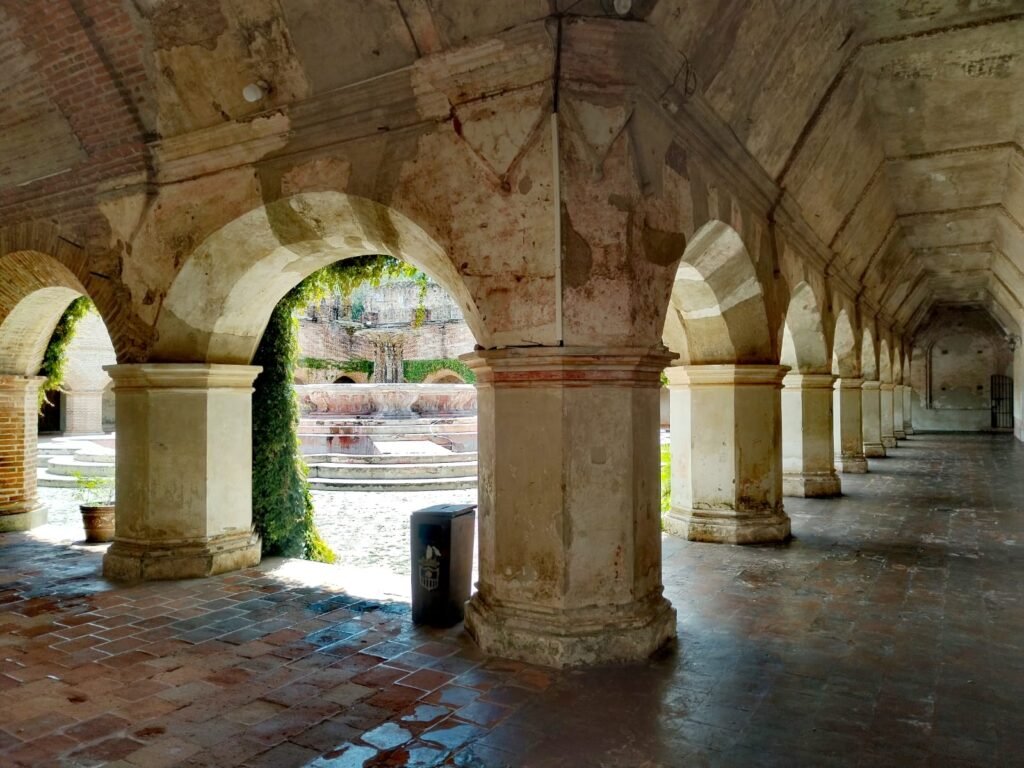
La Merced, like most of Antigua’s large colonial complexes, suffered the ravages of earthquakes (1751, 1773) and required numerous repairs. Despite this, its main façade remains in use as an active church, and its convent has undergone consolidation work that allows access to the large fountain and courtyards, which now serve as cultural and tourist spaces. The contemporary approach to the complex seeks to harmonize public access with conservation, integrating visitor flow management, interpretive signage, and technical stabilization efforts. laantiguaguatemala.com
La Merced in the city: urban iconography and collective memory
The church and its convent are not merely architectural objects: they are urban landmarks. The monumental fountain has become a popular photographic backdrop and a stage for festivities; the façade, with its vibrant colors and intricate reliefs, serves as a backdrop for civic life. At the same time, questions about restoration, tourism, and heritage protection fuel debates among conservationists, authorities, and citizens. La Merced, therefore, remains a place where material history and contemporary life converge. suntuoguatemala.com
Recommendations for visitors and scholars
- Take your time visiting the church and convent: spend time in the courtyard and the fountain to appreciate the size and scale. Guatemala.com
- Read the information plaques and, if possible, request a local guide to contextualize the interventions and the artworks. laantiguaguatemala.com
- Respect the liturgical norms during religious celebrations and cooperate with the conservation measures (do not touch surfaces, follow marked routes). laantiguaguatemala.com
Conclusion
La Merced embodies the best of Guatemalan Baroque: construction techniques adapted to a seismic region, exuberant ornamentation crafted by local and foreign artisans, and a spatial configuration where water—that grand octagonal fountain—acts as both symbol and lifeblood of the convent. Visiting La Merced is to glimpse an essential chapter in Guatemala’s religious and artistic history, a space where architecture engages in dialogue with devotion and where the past continues to shape the present-day city. laantiguaguatemala.com
Recommended sources and links
- Church of Mercy (Wikipedia, general tab). Wikipedia
https://es.wikipedia.org/wiki/Iglesia_de_La_Merced_%28Antigua_Guatemala%29 - Convent and Church of La Merced — Antigua, Guatemala (historical and architectural record).laantiguaguatemala.com
https://laantiguaguatemala.com/monumentos/convento-e-iglesia-de-la-merced/ - What is the largest fountain in Antigua Guatemala? — LearnGuatemala (note about the convent fountain).Guatemala.com
https://aprende.guatemala.com/historia/cual-es-la-fuente-mas-grande-de-antigua-guatemala/ - Church of La Merced — article and fact sheet (LearnGuatemala).Guatemala.com
https://aprende.guatemala.com/cultura-guatemalteca/patrimonios/iglesia-la-merced-antigua-guatemala/ - Notes on ornamentation and mermaids in colonial fountains (AntiguaDailyPhoto, visual analysis).AntiguaDailyPhoto.Com
https://antiguadailyphoto.com/2014/03/30/fuente-de-las-sirenas-antigua-guatemala/
Heritage guide (CVC — Cervantes Virtual Center): Church and Convent of Our Lady of Mercy.
https://cvc.cervantes.es/artes/ciudades_patrimonio/antigua/paseo/convento_merced.htm
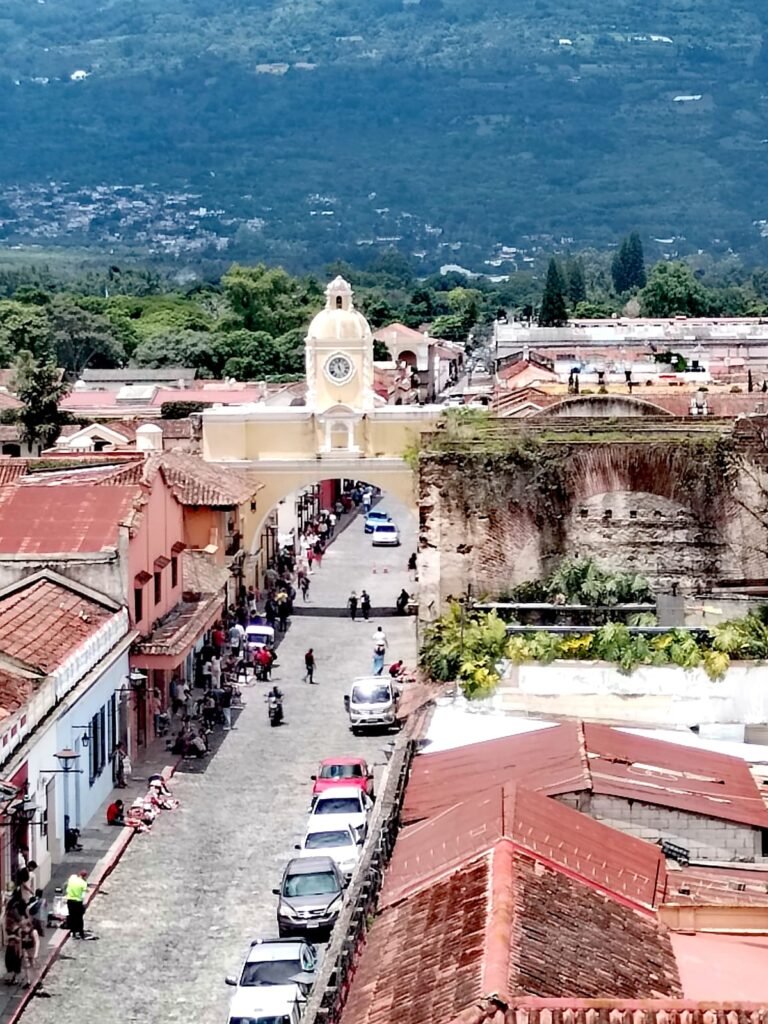
Vistas increíbles desde la terraza de La Merced. Todo un espectáculo visual y un excelente punto para ver la geografía de Antigua Guatemala.