
The National Palace of Culture (“Guacamolón”) and the Metropolitan Cathedral of Guatemala City
History, architecture, notable figures, tourism, current events and information of interest to visitors
🏛️ 1. National Palace of Culture (Green Palace / “Guacamolón”)
National Palace of Culture – Wikipedia (Brief historical summary and key facts)
History and construction
The National Palace of Culture, popularly known as Green Palace the “Guacamolón” Because of its characteristic green hue, it is one of the most representative buildings of Guatemala City and symbol of the Guatemalan state. Its construction took place between 1939 and 1943, by order of the general Jorge Ubico Castañeda and was officially inaugurated November 10, 1943.
Before this palace, several government headquarters existed on the site, but the idea of a modern national palace was revived by Ubico in 1932, formally beginning construction with the laying of the first stone in 1937.
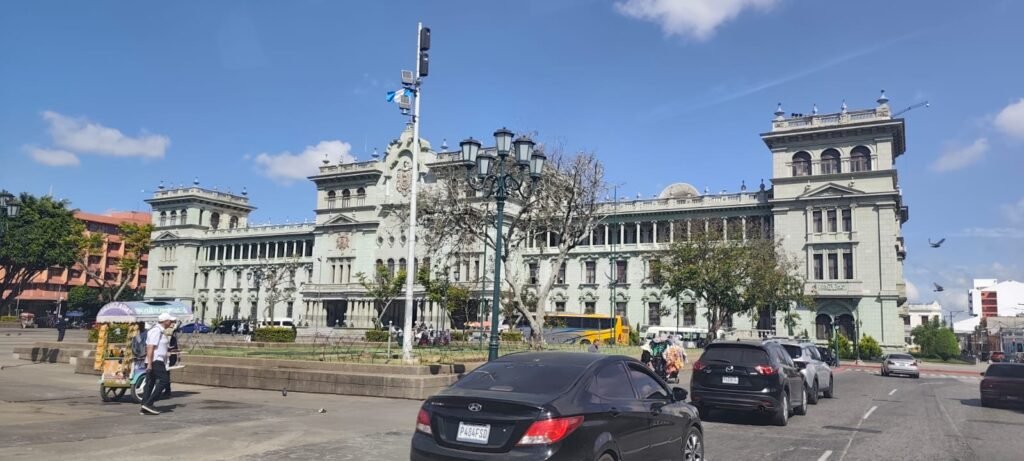
Architecture and design
The architecture of the Palace is an eclectic mix that combines:
- Style neoplateresco,
- Elements of Spanish Baroque and Renaissance,
- Details of Mudejar and national symbolism.
The building consists of:
- A central body with two lateral wings, each with three levels;
- A great inner courtyard with murals and fountains decorated in the traditional style;
- Interior murals that tell the story of Guatemala from pre-Hispanic times to independence.
Its distinctive color is not due to paint, but to a green artificial stone. The coating used is a mixture of cement and copper sulfate, giving it a permanent and unique appearance.
Historical and current function
Originally it was the seat of the Executive Branch housing government offices, ministries, and the Presidency itself. Over the years, government institutions gradually moved, and from 2001 the building belongs to the Ministry of Culture and Sports and it works as a museum, cultural center and site of ceremonial events.
Furthermore, the Palace is the kilometer zero of Guatemalan roads and a reference point for planning routes from the capital to the country’s departments.
Cultural and symbolic meaning
The Palace not only represents historical governmental power, but also identity and collective memory:
- Murals Guatemalan artists illustrate key episodes of national history.
- The center of the Patio de la Paz celebrates the signing of the Peace Accords of 1996, emphasizing reconciliation after the long internal armed conflict.
Related characters
- Jorge Ubico Castañeda (1878–1946): President who ordered the construction of the Palace.
- Rafael Pérez de León: Lead Guatemalan architect of the design.
- Alfredo Gálvez Suárez: Artist of the murals that tell the story of Guatemala.
⛪ 2. Metropolitan Cathedral of Santiago de Guatemala
Metropolitan Cathedral of Guatemala City – Wikipedia (History, architecture and essential facts)
History and context
The Metropolitan Cathedral of Santiago de Guatemala It is the main Catholic church in the country and the seat of the Archdiocese of Guatemala. Its construction began on July 25, 1782 —the day of the apostle Santiago— and was officially completed March 16, 1815.
This temple replaced the earlier cathedrals destroyed by earthquakes in the old city settlement (today Antigua Guatemala and other locations).
Architecture
The Cathedral combines styles Neoclassical and Baroque although their austerity and solidity also respond to the need to withstand frequent seismic movements.
Key features include:
- Facade with two twin towers, completed in1867.
- Interior with spacious main nave, altars, altarpieces, sculptures and religious works that date mainly from colonial and republican times.
- A series of 12 pillars in front of the facade that commemorate victims of the internal armed conflict (from the 1960s to 1996).
Events and restorations
The Cathedral has survived numerous earthquakes (especially in 1917–1918 and 1976), which caused structural damage that was later repaired to ensure its historical integrity.
Inside there is also a Walcker German pipe organ from 1937, one of the few of its kind that is still in operation.
Religious and cultural role
Besides being the liturgical and spiritual center of the capital, the Cathedral houses sacred works of art, historical altarpieces and religious archives. Its exterior square is the epicenter of civic and religious celebrations, such as Holy Week, patron saint festivals, and official events.
📍 3. Plaza de la Constitución: Civic heart of the city
Between the National Palace and the Cathedral lies the Constitution Square (or Central Park) This square is a space where parades, official events, and patriotic festivities are held. It has been the setting for… demonstrations, student parades and cultural events throughout national history.
🧭 4. Tourism and visits
National Palace of Culture
- Location: 6th Street and 6th Avenue, Zone 1.
- Guided tours available with historical and artistic explanation.
- Entry: Fees usually apply to foreigners; nationals with DPI at a lower cost or free depending on the season.
- It is suitable for photography, exhibitions and cultural events.
Catedral Metropolitana
- Location: 7th Avenue between 6th and 8th Street, Zone 1.
- Free access to the church, internal spaces and religious art.
- Recommended for appreciating sacred art, architecture and spiritual heritage.
🏨 5. Recommended nearby hotels
For tourists wishing to stay near the civic and historical axis of Guatemala City:
⭐ Zone 1 / Historic Center
- Boutique and cultural hotels within walking distance of the Palace and the Cathedral.
⭐ Zona Viva / Zona 10
- Hyatt Centric Guatemala City
- InterContinental Real Guatemala by IHG
- Barceló Guatemala City
These options offer modern comfort and easy access to transportation and tourist services.
📌 6. Current events and legacy
- The National Palace is currently used as cultural center, museum and venue for official government events, revived by recent policies that seek to return it to the people.
- The Cathedral remains a bastion of faith and heritage, with ongoing liturgical activities and heritage maintenance under Guatemalan regulations for the protection of cultural assets.
🔗 Reference links
📌 National Palace of Culture – Wikipedia
https://es.wikipedia.org/wiki/Palacio_Nacional_de_la_Cultura_%28Guatemala%29
📌 History of the National Palace – Guatemala.gob.gt
https://guatemala.gob.gt/palacio-nacional-de-la-cultura-un-tesoro-arquitectonico-de-la-cultura-y-el-patrimonio-de-guatemala/
📌 Metropolitan Cathedral of Santiago de Guatemala – Wikipedia
https://es.wikipedia.org/wiki/Catedral_de_Ciudad_de_Guatemala
📌 Constitution Square (Guatemala)
https://es.wikipedia.org/wiki/Plaza_de_la_Constituci%C3%B3n_%28Ciudad_de_Guatemala%29